


CNC Machining Centres Explained: VMC Vs. HMC
Introduction
CNC (Computer Numerical Control) machining centres are highly advanced and versatile machines designed to perform a wide range of complex manufacturing operations with exceptional accuracy and repeatability. These machines operate through computerised controls that automate tasks such as drilling, milling, turning, and tapping functions that would traditionally require manual input on different equipment.
A key feature of CNC machining centres is their integration of automatic tool changers (ATCs), which allow the machine to switch between tools mid-process without human intervention. This dramatically reduces setup time and eliminates many of the inefficiencies associated with manual tool changes, contributing to a smoother and faster production cycle. Modern machining centres may also include additional features like multi-axis movement, coolant systems, and integrated measuring probes to further streamline operations.
Thanks to these capabilities, CNC machining centres are essential in industries where precision, speed, and reliability are critical. Sectors such as aerospace, automotive, electronics, and medical device manufacturing rely heavily on CNC machining to meet tight tolerances and maintain consistent quality in high-volume production.
Moreover, because the process is controlled by digital programming, manufacturers can quickly adapt to design changes or new product requirements without extensive retooling, thereby making CNC machining centres not only efficient but also highly flexible in a competitive production environment. Quality models, such as the Hurco 5-axis machines offer industry-leading technology and outstanding value for money, providing Australian manufacturers with a reliable and competitive solution for a wide range of CNC machining applications. You can browse CNC machining centres here, or scroll down to learn more.
Typical Operations Performed on CNC Machining Centers
A CNC machining centre is a computer-controlled tool designed to carry out precise operations like milling, drilling, and cutting with high efficiency. By following pre-programmed instructions, it automates the manufacturing process, improving both accuracy and speed while significantly reducing the chance of human error. This makes it a dependable choice for industries that require tight tolerances and consistent quality. CNC machining centres are also highly adaptable — they can be reprogrammed for different jobs, offering a flexible and cost-effective solution for a wide range of production requirements. With CNC machining, you can expect expert craftsmanship when it comes to…
- Drilling: CNC drilling involves using a rotating drill bit to produce accurate, consistent holes in a workpiece. The automated control allows for precise positioning, depth control, and repeatability across multiple parts, making it ideal for high-volume production and components requiring exact hole placement.
- Milling: Milling with a CNC machine uses high-speed, multi-point rotating cutters to remove material from a solid block to achieve the desired shape. It’s especially effective for creating complex geometries such as slots, pockets, contours, and 3D surfaces. With multi-axis capabilities, CNC milling can produce highly intricate and custom-shaped components with excellent surface finishes.
- Tapping: CNC tapping is the process of cutting internal threads into a drilled hole, allowing bolts, screws, or other fasteners to be securely attached. The precision of CNC systems ensures consistent thread quality, reduces the risk of breakage, and supports both standard and custom thread profiles, even in tough materials.
- Boring: Boring is used to refine and enlarge existing holes with high precision. CNC boring improves dimensional accuracy and surface finish, especially when tight tolerances are critical. It is often used in applications like engine blocks or hydraulic cylinders where alignment and sizing are essential.
- Grinding: CNC grinding employs abrasive wheels to achieve extremely fine finishes and high dimensional accuracy. It’s typically used for the final finishing stage of parts that require very smooth surfaces or close tolerances, such as hardened steel components or cutting tools. CNC control allows for exact shaping and consistent quality, even with complex part geometries.
Types of CNC Machining Centres
CNC machining centres are generally available in two main configurations: Vertical Machining Centres (VMCs) and Horizontal Machining Centres (HMCs). Each is designed to meet specific manufacturing needs, with their layout and capabilities tailored to suit different types of machining applications. Each type of CNC machining centre — vertical, horizontal, and 5-axis — offers distinct benefits tailored to specific production needs. While VMCs are ideal for space-conscious shops focusing on precision work, HMCs are built for heavy-duty tasks and high-volume runs. 5-axis machines, on the other hand, unlock complex part manufacturing with unmatched flexibility and accuracy.
Vertical Machining Centres (VMCs)
Spindle Orientation: Vertical
Design Features: Typically compact and space-efficient, VMCs are designed to maximise floor space in workshops and factories.
Applications: Commonly used across industries such as metal fabrication, automotive, and aerospace, VMCs are especially well-suited for working on flat or moderately contoured workpieces. They excel at milling, drilling, tapping, and cutting operations.
Ideal For: Machining small to medium-sized components, custom or one-off jobs, and high-precision tasks where easy operator access is beneficial.
Key Advantages:
- Simplified setup and tool changes
- Excellent for detailed, intricate machining work
- More affordable and compact, making them ideal for smaller operations or workshops with limited space

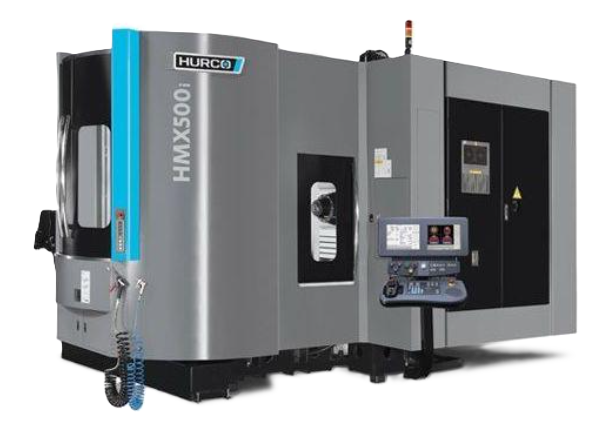
Horizontal Machining Centres (HMCs)
Spindle Orientation: Horizontal
Design Features: Built with a rigid structure and a larger footprint, HMCs are capable of accommodating larger, heavier, or awkwardly shaped parts.
Applications: Favoured in industries such as aerospace, defence, mining, and heavy equipment manufacturing, HMCs are engineered for intensive, high-volume production environments.
Ideal For: Large-scale parts, long production runs, and materials requiring high-efficiency metal removal.
Key Advantages:
- Natural chip fall due to gravity improves cooling and reduces downtime
- Higher material removal rates (MRR), boosting throughput
- Often equipped with Automatic Pallet Changers (APCs) to support continuous, unattended operation
5-Axis Machining Centres
For more advanced requirements, 5-axis machining centres represent the next level in CNC technology. These machines move the cutting tool or workpiece along five different axes simultaneously, allowing complex geometries to be machined in a single setup.
Applications: Critical in industries such as aerospace, medical device manufacturing, and advanced automotive engineering, where complex components demand high precision from multiple angles.
Advantages:
- Significantly reduces the number of setups needed
- Enhances part accuracy and surface finish
- Improves overall machining efficiency
- Requires skilled operators and seamless CAD/CAM software integration for optimal results
So Which is the Right Choice for Your Machining Needs?
Selecting the right CNC machining centre for your requirements involves careful assessment of several key factors. If you’d like a CNC machining centre that enhances both your production efficiency and workflow precision, then we recommend taking the following factors into consideration before making your decision:
- Part Size & Complexity: The size and complexity of the parts you intend to manufacture will dictate the specifications and capabilities needed from your machining centre. Ensure the machine can accommodate both the dimensions and detailed features of your parts.
- Material Type: Different materials require specific tools and machining processes to achieve optimal results. Verify that the chosen machine can handle the materials you plan to work with, whether it’s metals, plastics, or composites. Different types of CNC centres, such as Vertical, Horizontal, and 5-Axis, are designed for various applications and industries, so matching the right machine to your material needs is crucial.
- Production Volume: Take into account the number of parts you need to produce. For large-scale production, a machine with faster speeds and higher automation capabilities might be necessary to maintain efficiency and meet deadlines.
- Other Variables: Be sure to evaluate additional factors such as machining accuracy, spindle speed, tooling compatibility, integration with automation systems, and overall power consumption to ensure the machine meets your production goals.
The Benefits of Investing in a Quality CNC Machining Centre
CNC machining centres are fundamental to the efficiency and success of modern manufacturing operations. Investing in a top-tier machine, such as a Hurco, can provide significant benefits to your business. Here’s how:
- Increased Productivity: CNC machines automate numerous tasks, which reduces the need for manual labor and enhances output, allowing you to produce more in each shift.
- Improved Part Quality: CNC machining ensures high precision and repeatability, consistently delivering parts with tighter tolerances and exceptional quality.
- Lower Labor Costs: With automation handling much of the work, you can minimize manual intervention, reducing labor costs and optimizing how resources are allocated within your operations.
- Handling Complex Geometries: Advanced CNC machines can easily tackle intricate designs and complex geometries, allowing you to expand the range of possibilities for your parts and products.
- Maintaining a Competitive Edge: By incorporating state-of-the-art technology into your processes, you can produce parts that meet or surpass industry standards, giving you an edge over competitors and positioning your business for continued success.
Explore CNC Machining Centres at Applied Machinery
Ultimately, investing in a Hurco CNC machining centre can significantly elevate your manufacturing operations, offering enhanced productivity, precision, and cost savings. Whether you're in need of a vertical or horizontal machining centre, Hurco machines provide the reliability and versatility necessary for a wide range of CNC tasks.
If you’re ready to take your production to the next level, you can explore our range of CNC machine centres here, browse our other popular machinery here, or contact Applied Machinery for direct assistance today.
