


Why Industrial Water Chillers Are Essential
Industrial water chillers play a critical role in companies everywhere. Also known as air-cooled chillers or water-cooled chillers, they reduce heat from heavy machinery, regulate the temperature of sensitive materials, and optimise production cycles, making them essential for sustaining productivity and avoiding costly downtime. Recent advancements in industrial water chiller technology have enhanced the performance, efficiency, and reliability of industrial chillers everywhere, thereby solidifying their importance for businesses around the globe. You can scroll down to learn more, or browse the best industrial water chillers in Australia here.
What Exactly is an Industrial Water Chiller?
An industrial water chiller is a specialised refrigeration system designed to cool liquids or machinery in industrial and commercial settings. Its main function is to absorb excess heat and maintain the ideal temperature for equipment, processes, or products, ensuring efficient performance. This is accomplished by circulating a cooling fluid, typically water, through a refrigeration cycle that facilitates heat exchange. Industrial cooling systems such as these lower the temperature of the water below ambient levels, which is then used to cool equipment or products, either directly or indirectly, providing ideal cooling solutions for manufacturing sectors everywhere. Depending on the type of chiller, the heat is released into the environment through either air or water.
Why Do You Need a Chiller System?
In essence, industrial chiller systems prevent costly damage and keep productivity high while keeping downtime low by mitigating heat generation. Heat generation is an unavoidable consequence of various industrial processes; whether it's friction in heavy machinery, or the intense heat from equipment like furnaces and engines, excess heat can accelerate wear and negatively impact production quality. To address these issues, industrial chillers are designed to:
- Extend Equipment Lifespan: Chillers help maintain consistent, cool temperatures, preventing overheating and significantly extending the lifespan of machinery.
- Increase Efficiency: Cooling systems minimize downtime, prevent overheating, and accelerate production cycles, which leads to enhanced operational efficiency everywhere.
- Boost Product Quality: Keeping a stable temperature throughout production ensures that products consistently meet quality standards
How to Select the Right Industrial Chiller for Your Application
Choosing the right industrial chiller involves considering several factors that impact the performance, cost, and efficiency of your cooling system. Here’s what to keep in mind when selecting the best chiller for your needs:
- Cooling Capacity: When selecting the best chiller for your company, choosing the right cooling capacity (measured in tons or kW) is critical to ensure that it meets the cooling demands of your operations. If the chiller's capacity is too small, it may struggle to maintain the desired temperature, leading to overheating, inefficiency, and potential equipment damage. On the other hand, a chiller with an oversized capacity can result in higher upfront costs, increased energy consumption, and unnecessary space usage. Cooling capacity for industrial chillers is typically measured in tons or kilowatts (kW). A "ton" of cooling is a standard measurement that refers to the amount of heat required to melt one ton (2000 lbs) of ice in 24 hours, which equals 12,000 BTUs per hour.
- Temperature Requirements: Consider whether your operation demands chilled water at a specific temperature for optimal performance, or if your system can function within a wider temperature range. A precise temperature control is essential for industries that require strict temperature management for product quality, while a broader range might suffice for less sensitive applications.
- Energy Efficiency: Opt for chillers that boast higher energy efficiency ratings to help reduce long-term operational costs. Energy-efficient models typically use advanced technologies to optimize energy consumption, reducing your carbon footprint and saving on electricity bills, which can make a significant difference over the lifespan of the system.
- Maintenance: Take into account how easy the chiller is to maintain, including how often it needs servicing and whether it has features that simplify maintenance tasks. A chiller with self-diagnosis capabilities or easily accessible components can significantly reduce downtime and ensure your system remains reliable and functional with minimal effort.
- Space & Installation Requirements: Always ensure that the chiller you select is going to fit within the designated installation space and meets the specific requirements of your facility. Consider factors such as airflow, accessibility for repairs, and power supply needs, as well as whether the installation site allows for future expansion or modifications if required. This can help streamline the installation process and minimize disruptions to your operations.
Types of Industrial Chillers
Industrial chillers typically come in two primary forms; Air-Cooled Chillers, and Water-Cooled Chillers. They differ in how each cools the refrigerant gas during the cooling cycle.
Air-Cooled Chillers
Air-cooled chillers rely on ambient air to cool the refrigerant gas, using large fans to transfer heat into the surrounding environment. These systems are often installed in areas with good airflow and don’t require a cooling tower. The benefits of an air-cooler chiller include:
- A simple installation and maintenance.
- An operation that doesn’t need to rely on a cooling tower or water supply.
- A set-up that’s perfect for areas with limited water access.
Water-Cooled Chillers
Water-cooled chillers use water from a cooling tower to cool the refrigerant gas, which then chills water that circulates through the system. The advantages of a water-cooler chiller include:
- A more energy-efficient, especially in larger systems.
- A quieter operation.
- More consistent cooling, particularly in hot climates.
Why Should I Buy a New SML Air-Cooled or Water-Cooled Water Chiller?
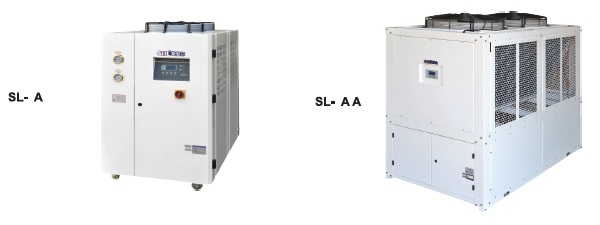
If you're based in Australia and on the hunt for a dependable, energy-efficient industrial chiller, then we here at Applied Machinery strongly recommend the all new SML Air-Cooled Water Chillers. Such high-quality industrial chillers offer multiple benefits that can greatly improve your business operations. Whether you're overseeing a manufacturing plant, industrial facility, or commercial space, these advanced chillers promise to deliver reliable, efficient, and cost-effective cooling solutions.
To learn more, scroll down to check out some of the most popular SML water chillers from Applied Machinery.
SML SL-30W Water Cooled Water Chiller
The New SML SL-30W Water Cooled Water Chiller boasts an impressive refrigeration capacity of 15kW (12,900 Kcal/h) and is powered by a 5HP (3.7kW) compressor. This system includes a 90L water tank and features a 25.4mm (1 inch) cool water pipe diameter with a flow rate of 90L/min and a total flow rate of 5.4 cu.m/h. Designed with a shell-type condenser, the chiller is equipped with essential safeguards, including protection against high and low pressure, as well as safeguards for compressor and pump overloads. It uses R407C refrigerant, with a charge of 2.5kg.
New SML SL-10A Air Cooled Water Chiller
The SML SL-10A Air Cooled Water Chiller offers a refrigeration capacity of 30kW (25,800 Kcal/h) and is powered by a 10HP (7.5kW) compressor. It uses R407C refrigerant with a charge of 5kg. The chiller features a large 180L water tank and a 38.1mm (1.5 inch) cool water pipe diameter. With a flow rate of 210L/min and a total flow rate of 11 cu.m/h, it ensures efficient cooling. The fan system includes two 0.45kW axial flow type blower fans for optimal air circulation. For added safety, the chiller is equipped with protection against high and low pressure, as well as safeguards for compressor and pump overload.
SML SL-20W Water Chiller- Water Cooled
The SML SL-20W Water Chiller features a refrigeration capacity of 15kW (12,900 Kcal/h) and is powered by a 5HP (3.7kW) compressor. It uses R407C refrigerant with a charge of 2.5kg. The 90L water tank supports efficient cooling, while the 25.4mm (1 inch) cool water pipe diameter ensures a flow rate of 90L/min, totaling 5.4 cu.m/h. The chiller is equipped with a shell-type condenser and incorporates safeguards, including protection against high and low pressure, for reliable and secure operation.
SML SL-60A Water Chiller - Air Cooled Water Chiller
The SML SL-60A Water Chiller provides a robust refrigeration capacity of 180kW (154,800 Kcal/h) and is powered by a 60HP (45kW) compressor. Using R407C refrigerant with a charge of 35kg, it features a 101.6mm (4 inch) cool water pipe diameter and provides a cool water flow rate of 550L/min, totaling 33 cu.m/h. The chiller is equipped with four axial flow type blower fans (1.8kW each) for optimal cooling efficiency. Key safeguards include protection for high and low pressure, compressor and pump overload protection, antifreeze protection, and flow rate protection.
Contact Applied Machinery For Your New Water Chiller in Australia
Industrial water chillers play a vital role across various industries by providing an efficient and reliable cooling solution that can protect equipment, boost production efficiency, and uphold product quality. Whether your preference is an air-cooled or a water-cooled chiller, Applied Machinery can help you find the system and model that’s perfectly suited to your company’s specific cooling requirements. So if you’re ready for a high performance chiller to optimise your operation, get in touch with Applied Machinery today to explore our selection of Air-Cooled and Water-Cooled Water Chillers. You can also head over to the Applied Machinery homepage to check out our many other high quality products.
