


Fiber laser cutting has rewritten the rules of metal fabrication. In little more than a decade it has gone from promising newcomer to the default choice for cutting sheet and plate — faster, cleaner and cheaper to run than the technologies it replaced. Here’s how it works, where it excels, and what to weigh up when you buy.
THE FUNDATMENTALS
What is fiber laser cutting?
A fiber laser is a solid-state laser in which the beam is generated and amplified inside an optical fibre doped with the rare-earth element ytterbium. Banks of pump diodes excite that fibre, producing an intense near-infrared beam with a wavelength of about 1.06 microns — roughly a tenth of that of an older CO₂ laser. That much shorter wavelength is absorbed far more readily by metals, and almost every advantage that follows flows from it.
The beam travels to the cutting head through a flexible fibre-optic cable; there are no mirrors or laser gases in the beam path. At the workpiece, the focused beam melts and vaporises the metal while a high-pressure assist gas blows the molten material out of the cut, leaving a narrow, clean kerf guided by CNC motion.
THE CUTTING PROCESS
How a fiber laser actually cuts
Five stages turn a beam of light into a precise, repeatable edge. The art — and where machine quality really shows — lies in how finely focus, gas and speed are tuned to each material and thickness.
Focus
A lens concentrates the beam to a spot a fraction of a millimetre wide, raising power density enough to melt steel instantly.
Pierce
The beam penetrates the sheet, creating a starting hole before the cutting path begins.
Cut
CNC motion drives the head along the contour as the beam continuously melts the kerf.
Eject
High-pressure assist gas blasts molten metal down and out of the kerf, keeping it clean.
Edge
A narrow kerf and small heat-affected zone leave a precise, near-finished edge.
WHY THE INDUSTRY SWITCHED
Fiber versus CO₂ laser
If you learned to cut on a CO₂ laser, the move to fiber is dramatic. The two technologies share a name but little else — and for cutting metal, fiber wins on nearly every measure that matters on the shop floor.
Fiber laser
- 30–50% wall-plug efficiency
- Cuts reflective copper, brass & aluminium
- 2–4× faster on thin sheet
- No mirrors or laser gas to maintain
- Compact footprint, lower running cost
CO₂ laser
- 5–10% wall-plug efficiency
- Struggles with reflective metals
- Slower on thin and medium gauge
- Mirror beam path needs alignment
- Laser gas & higher maintenance load
Modern high-power fiber sources with beam-shaping technology have closed the historic thick-plate edge-quality gap, leaving few reasons to specify CO₂ for metal cutting today.
THIN & MEDIUM GAUGE
Why fiber excels at sheetmetal
On everyday sheetmetal, fiber’s combination of speed, precision and clean edges is hard to beat — and it keeps secondary processing to a minimum.
Blistering speed
On 1–6 mm sheet a fiber laser runs several times faster than older technology — throughput per shift climbs sharply.
Fine precision
A narrow kerf and tight tolerances allow intricate detail, small holes and crisp internal corners with no tooling to change.
Reflective metals
Stainless, aluminium, copper and brass all cut cleanly — the very materials that defeated CO₂ lasers.
Weld-ready edges
Nitrogen cutting leaves bright, oxide-free edges ready to weld, fold or paint with no secondary cleaning.
Small heat zone
Concentrated energy means a minimal heat-affected zone and far less distortion on thin or delicate parts.
Automation-ready
Fast, repeatable cuts pair naturally with load/unload and tower storage for hands-off, lights-out running.
HEAVY FABRICATION
Stepping up to thick plate
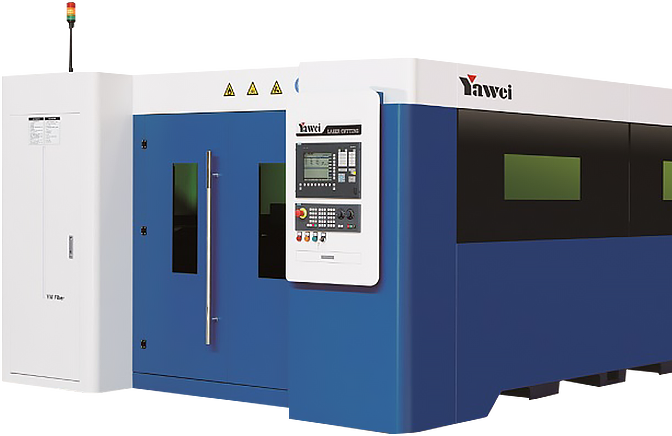
As source power has climbed to 12, 15, 20 and 30+ kilowatts, fiber has moved well beyond sheet into heavy plate fabrication once reserved for plasma and oxy-fuel. The Yawei fiber laser range, for example, spans light-gauge sheet right through to heavy structural plate.
Power unlocks thickness
Higher kilowatts extend maximum thickness and dramatically speed up cutting across the plate range in between.
Bevel & weld prep
Bevel-capable heads cut chamfers and V-prep edges in a single pass, removing a separate machining step.
Beam shaping
Adjustable beam profiles tune the cut for thin or thick material, holding edge quality right across the range.
Consistent edges
Stable, repeatable plate edges reduce grinding and rework before downstream welding.
CAPACITY AT A GLANCE
Source power vs. cutting capacity
More power buys two things: greater maximum thickness, and faster cutting through the range in between. The chart below shows indicative maximum thickness in mild steel across common power levels.
PROCESS CHEMISTRY
Assist gas: the silent variable
The gas that clears the kerf shapes cut speed, edge quality and running cost as much as the laser itself. Three options cover almost every job.
Oxygen
An exothermic reaction adds energy, boosting speed on thicker carbon steel. It leaves a lightly oxidised edge that may need cleaning before paint or weld.
Nitrogen
An inert, high-pressure gas that produces bright, oxide-free edges ready for welding and coating. Higher consumption raises the cost per metre.
Compressed air
The lowest-cost option — a blend of nitrogen and oxygen straight from a compressor. Excellent on thinner mild steel and aluminium.
BEYOND THE CUTTING HEAD
Automation & the lights-out shop
A fiber laser’s speed is only fully realised when material keeps flowing through it. Integrated automation turns a fast machine into a continuous production cell — and is where much of the real-world payback lives.
Tower storage
Multi-shelf material towers stage raw sheet and stack finished blanks, feeding the laser without a forklift.
Auto load / unload
Shuttle tables and pallet changers swap sheets in seconds, keeping the beam cutting instead of waiting.
Lights-out running
Buffered material lets the cell run unattended through nights and weekends for genuine 24/7 output.
Smart nesting
Software packs parts tightly onto each sheet, lifting material yield and cutting scrap automatically.
Production monitoring
Live dashboards track uptime, throughput and consumables for data-driven scheduling.
Connected workflow
Jobs flow from office to machine and back, linking quoting, programming and the shop floor.
THE BUSINESS CASE
Lower cost per part, higher uptime
Fiber’s efficiency shows up directly on the operating ledger — in power, consumables and labour. Faster cutting plus longer uptime means the same shift produces more parts, which is the real lever behind return on investment. Some Australian fabricators report payback on a new fiber laser in as little as 12–18 months.
SPECIFYING THE RIGHT MACHINE
How to choose the right machine
The best fiber laser is the one matched to your material mix and throughput — not simply the highest wattage on the brochure. Six things are worth weighing up before you commit.
Material & thickness range
Map your real job mix — grades, gauges and the heaviest plate you genuinely cut — to the right power band.
Throughput & duty cycle
How many hours, shifts and parts? High utilisation justifies more power and automation.
Bed size & format
Match the sheet format (1530, 2060, 2560 and larger) to your stock and part sizes to minimise offcuts.
Automation roadmap
Decide whether towers and load/unload come on day one, or as a planned upgrade path later.
Gas & power infrastructure
Confirm assist-gas supply, compressor capacity and electrical service before installation day.
Support & spares
Local service response, training and parts availability protect uptime for the life of the machine.
Key takeaways
- Fiber is the standard for metal cutting — efficient, low-maintenance and able to cut reflective alloys CO₂ can’t.
- Power scales from everyday sheetmetal to 50 mm-plus plate, with bevel heads and beam shaping for edge quality.
- Assist-gas choice and automation determine real-world cost per part and throughput.
- Specify to your material mix and duty cycle — then let towers and load/unload run it lights-out.
COMMON QUESTIONS
Fiber laser cutting FAQ
What is fiber laser cutting?
Fiber laser cutting uses a solid-state laser, generated inside a ytterbium-doped optical fibre, to melt and vaporise metal. A high-pressure assist gas blows the molten material out of a narrow kerf while CNC motion guides the head along the cut path. It is prized for its speed, precision and low running cost on sheet and plate.
Is a fiber laser better than a CO₂ laser?
For metal cutting, yes, in almost every respect. Fiber lasers are three to five times more electrically efficient, cut reflective metals such as aluminium and copper that CO₂ struggles with, run far faster on thin and medium gauge, and need no mirrors or laser gas. Modern high-power fiber sources with beam shaping have also closed the historic edge-quality gap on thick plate.
How thick can a fiber laser cut?
It depends on source power. As a guide for mild steel, a 3 kW machine cuts up to around 16 mm, 6 kW around 20–25 mm, and 12 kW around 30 mm, while 20–30 kW machines reach 50 mm and beyond. Actual capacity varies with assist gas, material grade and the edge quality you need.
What assist gas should I use?
Oxygen suits thicker mild steel where speed matters and a lightly oxidised edge is acceptable. Nitrogen gives bright, oxide-free edges on stainless and aluminium that are ready to weld or coat. Compressed air is the lowest-cost choice for thinner mild steel and aluminium.
Can a fiber laser cut aluminium, copper and brass?
Yes. The fiber laser's short (around 1.06 micron) wavelength is absorbed well by reflective metals, so stainless steel, aluminium, copper and brass all cut cleanly — a key advantage over older CO₂ technology.
TALK TO THE LASER SPECIALISTS
Looking at a fiber laser for your shop?
Applied Machinery is the Australian distributor for Yawei high-speed precision fiber lasers — from compact sheet cutters to high-power plate machines with tower automation. Tell us your material mix and we’ll help you specify the right system.
See the Yawei fiber laser range Contact our team
More than 30 years in Australian manufacturing · Service & support, every time · Call (03) 9706 8066
